Blue Inspiration

I recently read The Color Purple for a book club and not long after finishing the book I watched Sinners at the urging of my son (and the broader culture) and I was immediately struck by the overlapping ideas (setting, characters, music, themes) offered by both texts, but as this blog is not a book or movie review blog but rather one intended to inspire writing I want to start with the simplest inspiration of all: color.
While the theme of color (from skin to clothing) is important in both texts, I want to focus on the colors we choose to admire and celebrate as well as to reflect our identity and mood. We should begin with The Color Purple because it is right there in the title. When Shug shares her philosophy of the color purple in nature the setting and her affect as well as choice of words is a celebration of life and the world. I know I have always been personally drawn to purple and I have often associated it with Christian tradition. In Sinners the Smokestack twins are heavily color coded. Smoke wears blue to represent his quiet cool and more thoughtful temper. Stack wears red to represent his loud flamboyance and desire to make things happen. Red and blue are dominant colors throughout the film. Blue evokes rootedness: tradition, lineage, community. Red signals disruption and, often, destruction. In contrast we have their cousin Sammie who wears brown to represent his connection to the land and tradition. There is also beautiful use of the color white to represent salvation (Sammie’s father) and the afterlife (Smoke’s wife Annie). You might find writing inspiration in considering the important colors in your life and what they say about you and your influences. You can also think about other films/stories where color plays an important role.
Love in all its forms is also an important theme in both texts. Sisterhood as well as marriage (both traditional and nontraditional) come up often and cause conflict. Forbidden love or the dangers of love are both primary themes and subtexts. In The Color Purple Shug and Celie‘s relationship both changes Celie’s life and makes many characters (and readers/reviewers) extremely uncomfortable. In Sinners we see loving committed marriages (ie. Grace and Bo Chow) and infidelity (ie. Stack and Mary) both loves that ultimately led to destruction. I admit serious jealousy of the sibling relationships in both movies and the strong family bonds as well as the powerful friendships. You might be inspired to write about the important love in your life from romance to friendship to family. I know I was inspired by the loving communities we see in both texts.
Music plays an important part in both texts. Shug Avery plays a pivotal role in Celie’s life even before she walks into her home, but as their relationship develops Celie finds her power and music is an important part of the journey. While the Blues are central to both texts, this musical form is pivotal to the conflict in Sinners as shown in Sammie’s performance of I Lied To You (with all this scene encompasses). I know I find I Lied To You very thought provoking and perhaps you will find inspiration to write about the important musical influences of your life.
Both texts offer rich multi-textured explorations of culture and history that make The Color Purple a classic and I expect will make Sinners one as well. We are reminded of so many dangers of this time period for people of color and women and children in both texts. Even as we know that our society and laws have come a long way, we also know that both officers of the law and random white folks lynch people of color (both physically and financially) on the regular (and often get away with it); husbands still terrorize their wives; and we still look down on those we perceive as other. There are so many interesting explorations of oppressive systems in both texts from colonialism to patriarchy to religion. While you might not find this as interesting to explore as I do, but these are both rich sources of inspiration if you do. If nothing else you can borrow from Celie and write a letter to some important force or person in your life, because my final takeaway from pairing these two texts is that as terrible and full of horror as they are they ultimately left me full of hope for humanity. Alice Walker and Ryan Coogler are both master storytellers giving us richly drawn characters we can root for and celebrate and multi-layered stories full of inspiration.
Both texts also made me examine my own privilege. Recent decades have radicalized my own feminist convictions, but reading The Color Purple again helped me understand how both my comfortable traditional upbringing and marriage insulated me the worst predations of the patriarchy (as supported by both Christianity and capitalism). Both texts underlined the privilege I experienced (and continue to do so) as the descendent of white protestant Europeans. Some of my Dutch ancestors came over as contract farm labor during this reconstruction period (which does make me think about that coincidence?), but within a generation they owned their own farms. This was possible because they were paid with real money and not plantation scrip plus they had access to reasonable mortgages without fear of lynching and robbing if they looked too prosperous. I have lived in Eastern Kentucky for decades and I cannot help but see the echoes of these stories in the mining scrip and coal camps. Those rapacious industries have forever scarred the people and land of this region. Who are the real monsters and vampires who live among us? That is the power of good storytelling and the continued appeal of the horror genre – to challenge us to think about how our privilege protects us from those monsters and, worse, allows us to ignore their existence.
Even before multiple book clubs put more books on my to-be-read pile, Sarah Steward Holland introduced me to the idea of texts in conversation and I am finding this to be true in so many ways, but surely there must be a limit! What texts are in conversation in your life? If you are interested in more conversations about the texts in my life check out Deanna’s Third Act/Space and consider joining me on this journey.
What inspiration will you find in these stories of the Blues? Do not fret if you are inspired to think about the symbolism of color or the magic of music for your writing this week. Both texts are built around these core concepts, but do not forget the shades of darkness beneath the surface of these beautiful songs and stories.
Final thought/inspiration: Recently many of the podcasts I listen to have done some version of the movie of the year and many times those land on One Battle After Another while giving Sinners runner-up status. At least this conversation on Slate’s What Next put those movies in conversation with each other. I did very much enjoy One Battle, but it does not live on in my thoughts like Sinners has done. I am doing a book/movie club later this year with my son where we will read Vineland and rewatch One Battle. He adores One Battle so maybe that experience will shift my thinking. I do not want One Battle to be the movie of the year because it is such a celebration of white men and I do not want either Leonardo DiCaprio or Sean Penn to be the face of 2025 and while I do love Chase Infiniti’s portrayal of Willa Ferguson an episode of Glamorous Trash podcast where they discuss this movie helped me understand how much this movie centers the white male story and gives us so little about the actual interior lives of women and people of color. Sinners does not make that mistake and pushes at the same conflicts/sins as well as questions about humanity, love/family, and freedom, so my vote is for Sinners to be the movie of 2025. Where do you stand? What do you think is the movie of the year for 2025? Also, let’s be honest, doesn’t the movie of 2025 have to be a horror?
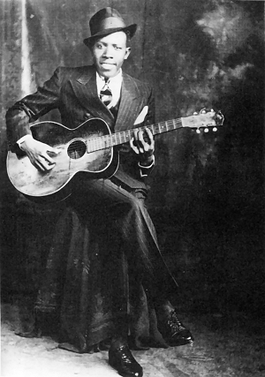
Image: By Copyright © 1989 Delta Haze Corporation.[2]The photograph was taken in 1936 by the Hooks Brothers Photographers studio, owned by Henry and Robert Hooks, located on Beale Street in Memphis.[3] In 1974, Johnson’s half-sister Carrie Thompson entered a copyright transfer agreement with Stephen LaVere in which she represented herself as Johnson’s sole and closest heir.[4] She agreed to transfer to LaVere “[a]ll of her right, title and interests, including all common law and statutory copyrights, in and to … a photograph of Robert L. Johnson taken by Hooks Brothers Photography in Memphis, Tennessee, and showing Johnson in a sitting position with a guitar running diagonally across his body …”[5]The photo was first published in 1989 in the journal 78 Quarterly (Vol. 1, No. 4) with LaVere’s permission.[6] It was most notably featured as the cover artwork for the 1990 release of The Complete Recordings, distributed by Columbia Records under license from LaVere.[7] In a series of subsequent court decisions, the Mississippi court system identified Claud Johnson of Crystal Springs, Mississippi as Robert Johnson’s sole heir and determined that he was entitled to royalties from LaVere’s 1974 contract. Claud Johnson died on June 30, 2015;[8] upon his death, the interest passed to his heirs, including Michael Johnson.[9], Fair use,